– The Story –
“Things must change if we wish them to remain the same.”
A story of generosity and greed.
Set in winter wilderness, the story moves from the world of ancient Nordic sagas to the snow plains of the Victorian Alps where young Edda must overcome her fears in a quest to save an ancient Arctic society. Confronted and challenged, she must decide what stand she will take in a world where greed has become a potent force. A decision that echoes choices for our own looming future.
Review
5 Stars achieved in every category
Appearance: Headings, and when possible, eye-catching illustrations.
Plot: The characters of a book should be well defined with strengths and flaws.
Development: Development refers to how effectively you told your story
Formatting: The way in which you describe scenes, display dialogue, and shift point of view.
Marketability: Marketability refers to how effectively you wrote your book for your target audience.
Overall Opinion: The overall starred rating takes into account all these elements and describes the overall reading experience of your reviewer.

The story is told in three connecting parts.
Part 1: Past
As a group of Nordic seafarers are on their way to raid a remote settlement, they are caught in a storm resulting in a new life subsisting secretly in the wilderness. Their isolation shields them from the ‘South’ where people live in large settlements out of touch with the natural world. The former seafarers (the Stórmenska), encounter the South people as they expand northward with dire consequences. Later, the Stórmenska rescue a ‘South boy’, lost in the wilderness who becomes a key to their continued existence.
Part 2: Present
The story follows Edda’s passage into early adulthood, when driven by persistent self-reflection and curiosity, she transforms from being a victim of her fears, to conquering them. While traversing Victoria’s High Country in winter her knowledge of the natural world is affirmed and her shortcomings exposed. Prompted by a series of mysterious riddles, she is drawn into helping an age-old civilisation (the Stórmenska) where she confronts some uneasy truths about herself and her own world, resulting in her taking a stand.
Part 3: Future
Confronting the prospect of unfettered greed causing the eventual demise of the natural world, a final riddle hints at a way forward. A way that hinges on lessons from the past when survival became the imperative for a band of seafarers.
For Teachers
For the Outdoor Education teacher. The story has a number of ‘lessons’ relating to traversing wilderness areas. Some of these lessons are cautionary tales relating to navigation, snowcraft, and a realistic assessment of abilities, including an understanding of wilderness environments and impending weather conditions. Other aspects of the story highlight the need for adequate training, preparation and planning.
For the English teacher the following is offered as some possible introductory discussion ideas; not as a ‘Response to Text’ format.
Response to Text Assignments
The key emphasis of a text response assignment: Often the emphasis falls into one or more of four board categories that often overlap and interact:
- Character-based: Focuses on motivations and development.
- Thematic: Explores broader ideas and concerns in the text.
- Structural: Requires analysis of literary devices and authorial choices.
- Values-based: Examines the author’s message or underlying moral stance.
- Character-based responses.
A purpose behind of having some in the narrative with dynamic character arcs, while others remain static?
An aspect of the Finder’s Keeper narrative is a melodrama between greed and generosity of spirit. For this reason, some characters are static. For example, the greedy Vansi clan is introduced in the nineth century. (‘on hearing of Himinnsled’s promise of prosperity, a lone shunned figure…felt his thoughts caught up in a silent frenzy.’ – page 6). By the early twenty first century not much had changed. (” Nothing is beyond measuring with money,” spat a rasping reply. – Page 160). Being symbolic of greed throughout the narrative, the Vansis’ character and motivations remain static. In a similar way Alex as a sage-like mentor with his lessons in navigation as a metaphor for lessons in life is constant rather than dynamic.
Harold Fairhair’s character on the other hand was dynamic with his change-of-heart while in the ‘Shangri-La’ like setting of the Hidden Valley. (‘The seafarers’ days of raiding were consigned to stories of a cruel past.’ – page 20), only to revert to type (‘…the warrior in Harold had re-emerged’ – page 33), indicating the enticing nature of greed or perhaps the vulnerability of a generosity of spirit. Edda’s development from being a victim of her fears to making a determined stand about something bigger than herself is a distinct development arc in Part 2 of the novel. A question for students could be: What might be some pivotal moments that indicate Edda’s development?
To what extent is the story driven by a series of events or by the interaction of the story’s characters?
The natural environment is described in different moods and states of well-being, elevating it potentially to a character in the story. What might be the purpose of it being portrayed as a (dynamic) character?
More to come…
2. Thematic based responses: An Exploration of broader ideas and concerns in the text.
3. Structural based responses: An analysis of literary devices and authorial choices.
4. Values-based responses: An examination of the author’s message or underlying moral stance.
For Young Adult Students
Some general ‘starters’ for a Young Adult student’s response to the text assignment.
Consider:
1. How the author expresses the ways protagonists and antagonists are distinguished and the reason for doing this in the overall story. For example, the author introduces a protagonist as having a “striking appearance – piercing sea-green eyes framed by a tumble of hair that cascaded to rest on broad shoulders…” (page 4). In contrast, the introduction of Grima Vansi (an antagonist),is introduced as being “a lone shunned figure crouching in a shadowy corner” (page 6).
2. Key concerns, values or opinions, and whether the author is supporting or denouncing an idea and why. For example, “We understood that they had already formed a connection with the land, rendering it theirs, not ours,” (page 19) may be an indication of relative respect, when compared with historic values in acquiring land. Similarly, “You… all seem to be fighting because you want more than what you have. Will that ever end?” (page 21) may indicate a view of the beguiling and corrosive nature of greed.
3. The social, historical, cultural standards embedded in the story that influence and position the reader. Chapter 14: ‘Wealth and Worth’ (page 153) delves into disagreement over values embedded in a (fictitious) traditional society and, a modern materialistic society.
4. Different interpretations of the story including the author’s intentional ambiguity. For example, Alex’s advice on how to successfully navigate the bush includes the comment “To really understand where you are in the world, you should look more closely to find evidence that your opinion is wrong.” Similarly, the use of metaphor in looking to the sky to see what the future (weather) might bring may refer to the future in a broader context.
5. The use of other literary devises to convey meaning such as personification, an example of which can be found on page three; “The murmur of the wind as it snuck in foretold of a gathering storm that would soon roar.”
The use of leitmotif. Here think of “The Imperial March”, Darth Vader’s reoccurring musical theme when he appears on screen in the film Star Wars, but in a literary form. In this narrative that extends well over a millennium, a simplified way of indicating possible family connections is by the recurrence of green eyes.
Simile is used throughout the text such as “Moving with the agility of an elf,” (on page 12) which is followed up with characters sharing similarities with a tightrope walker, a weightlifter and the like.
Foreshadowing. “Overnight, the anticipated storm arrived and moved on – or so it was thought,” is used as a device to indicate the impending return of a storm (page eight), or when indicating that in the future Harald would be “a celebrated Viking King,” (page ten).
Use of imagery and the senses is indicated by passages such as, “The stranger stooped through the doorway, abandoning the companionship of unsullied sea air in exchange for the musty smell of the hall’s dank stone walls and thatched roof.” Getting an image or feel for the inside of the hall employs the sense of smell. The stranger was not described as tall but as needing to stoop through the doorway; an example of ‘showing’ rather than ‘telling’.
Other devices that may be found in the story include irony, symbolism, alliteration, and hyperbole. The use of a prologue and epilogue and their reflective narrator from the future may be thought of as a device (for what purpose?). What is the purpose of describing numerous images and moods of the natural world, potentially elevating it to a ‘character’ in the story.
The literary devise of onomatopoeia was avoided – perhaps best left for use in comic books.
Finally, while it was desirable for the story to relate cooperation, joint effort and generosity to the imperative of basic survival for a group of people trying to subsist in a harsh natural environment, it was not desirable to then attribute this to any actual society or group, with the inevitable ill-informed assumptions that would flow from that attribution. For this reason, the society in the hidden valley along with its culture is fictitious and fabricated, intentionally obscure, but with some elements that hint at inspiration from various shamanistic and animist cultures of the Arctic, sub-Arctic and North and South America. In a similar way, some may find Frank Herbert’s Fremen in Dune as having similarities with prevalent imagery of Bedouin-like desert people or Steven Gould’s Na’vi society with their struggles in Avatar as being a metaphor for the struggles of the traditional inhabitants in the Amazon basin.
So…for the purposes of this story the origin of the first habitants of the hidden valley is obscured as archaic with hints of their identity in that they were there because of “being relentlessly hunted…(and) forced to continually move on as their oppressor’s empire kept expanding to the far reaches of the known world” (page 13). Their notional identity can be found in the origin of the word used by them to describe their language (if you want to check it out). With the subsequent addition of Vikings arriving at the hidden valley, it is hard to imagine a way that their world has not already been misappropriated, redefined (horns on their helmets – really!), misjudged, denigrated, co-opted and trivialised in film, television, novels, comic books, video games, printed T-shirts, tattoos, and notably, in historical accounts. Of course, in the case of historical accounts they are not alone.
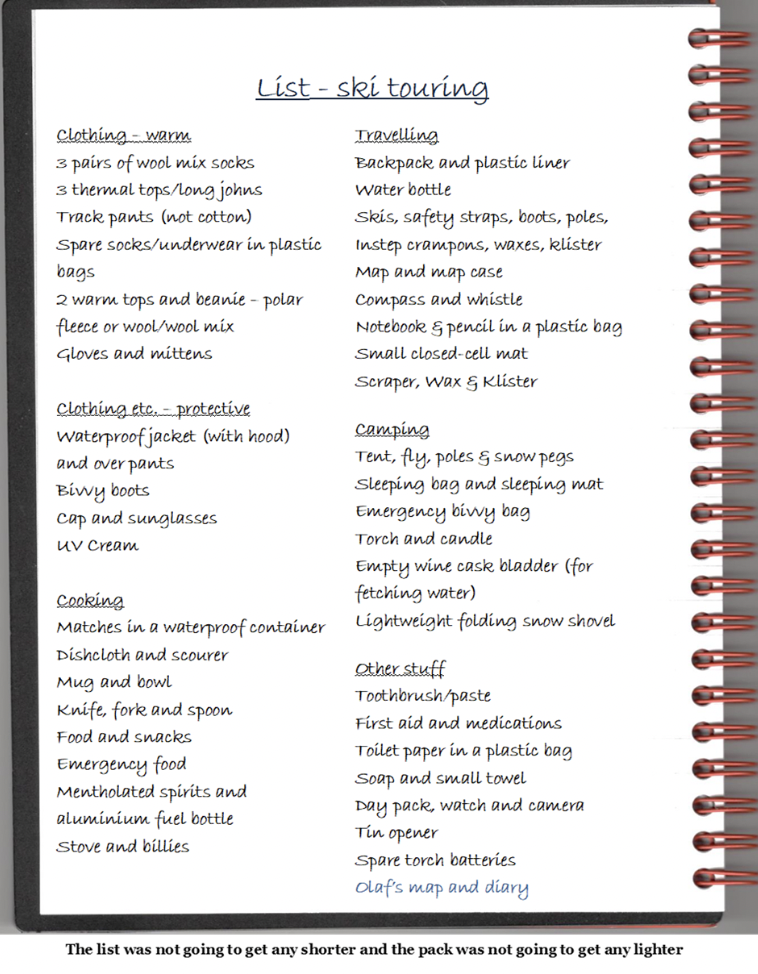
Edda’s clothing and equipment list for her quest.
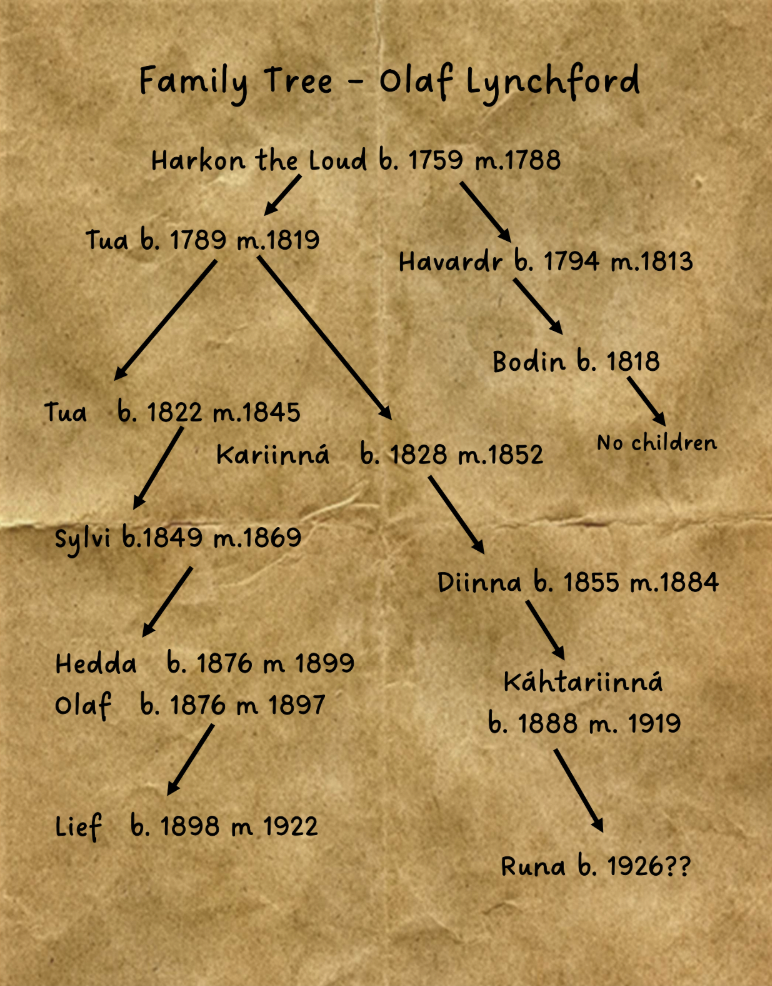
Alex’s family tree from Harkon the Loud up to his father’s marriage and the birth of the first of the Runa.
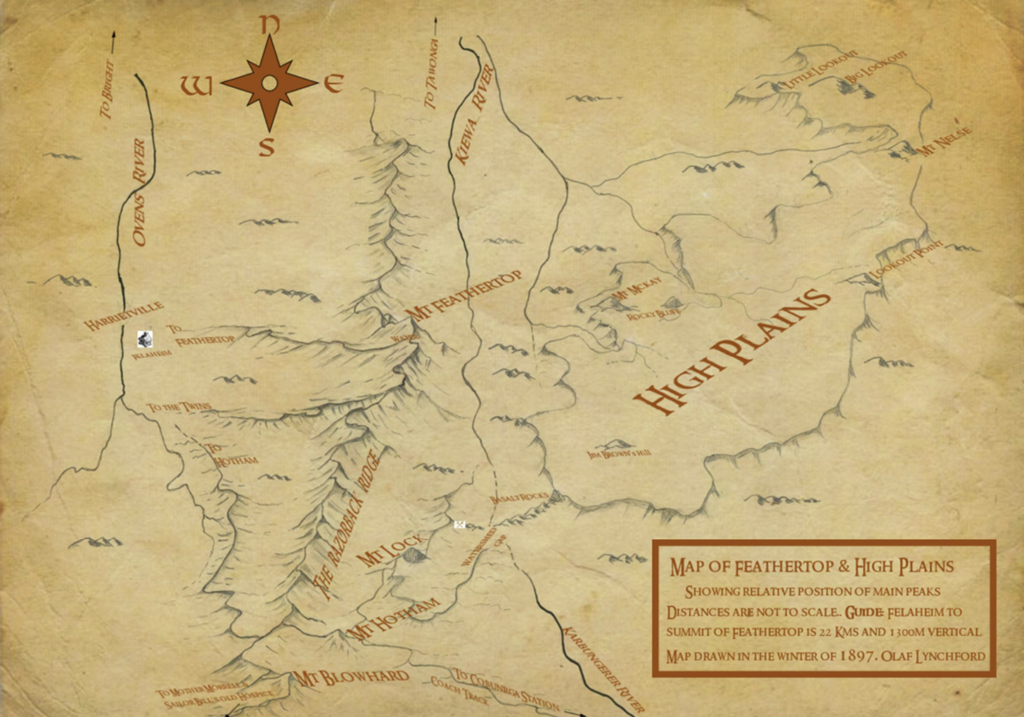
They learnt to trust the cryptic rhymes on the back of Olaf’s map.
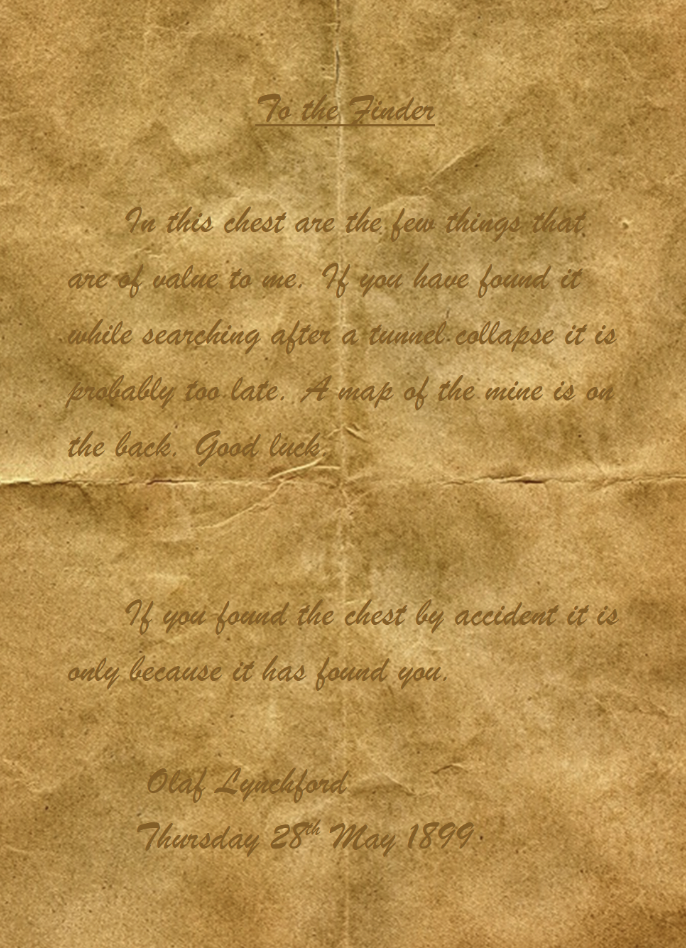
The letter that Edda and her grandfather found in the lost gold mine.