
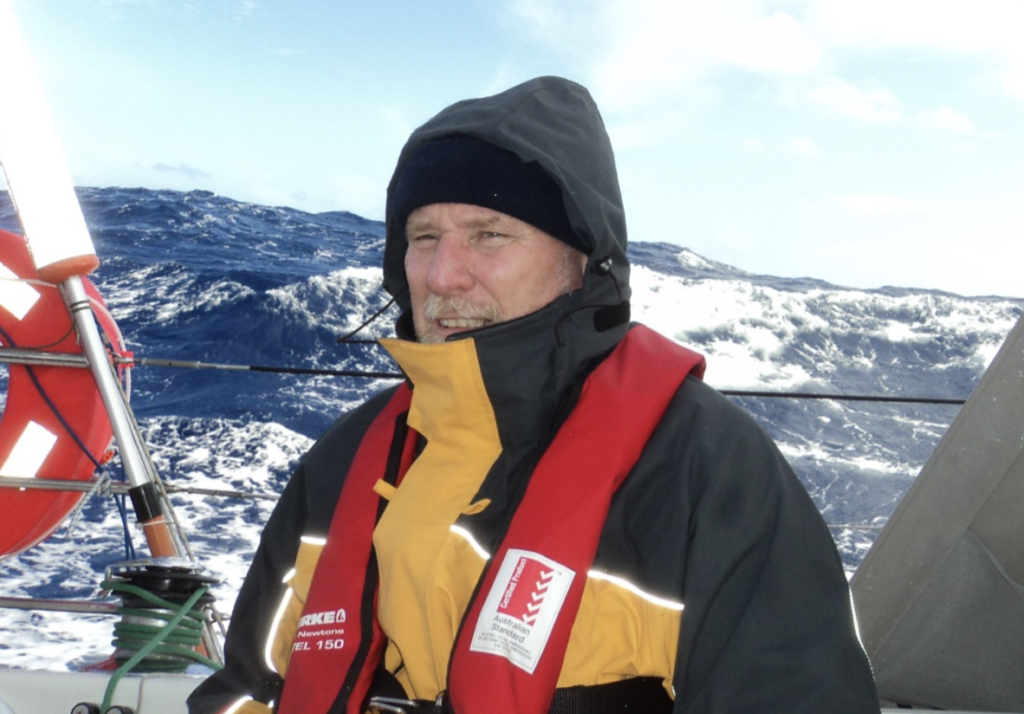
As a part of my working life, I was a senior secondary teacher, High School Principal and a manager in education administration. More recently I was a Founding Director of a company that is passionate about improving the standard of education and support for students and young adults. I live in Wangaratta, Victoria with my wife.
I developed an interest in visiting and better understanding remote, natural environments when I was posted to a school near the Great Dividing Range. There, many of the staff were keenly involved and well skilled in many outdoor pursuits. Over eight years at the school I soaked up their expertise, accompanied them on many trips into the mountains and undertook courses in cross country skiing, bushwalking/terrestrial navigation, rock climbing, remote area first aid, ski patrolling and, mountaineering/ice climbing in New Zealand. Later I joined an ocean racing crew where I was exposed to the various skills required for long distance sailing in remote areas before acquiring a yacht to set off on my own trips. As with mountain craft I again involved myself in courses such as ocean navigation, heavy weather sailing, weather patterns/route planning, emergency procedures, radio communications and the like.
During this period, and since, I spent much of my available free time traversing remote wilderness areas on skis in the Australian Alps, Norway and North America, mountaineering in New Zealand, and as a skipper on voyages along the coast of Australia, in the Southern Ocean, the South Pacific and the Mediterranean Sea. My volunteer work in the past has included cross country ski patrolling and as a member of a call out list to assist the Police Search and Rescue Squad, locating lost and injured cross country skiers and hikers in remote mountain areas.
My enthusiasm for furthering a better understanding and stewardship of the natural environment, and their related social issues lead me to develop and teach courses in Outdoor Education. As an extension of this, when the new Victorian Certificate of Education (VCE) was being proposed, I was invited to develop a VCE Outdoor Education course for Year 11 and 12 students statewide, and to provide the professional education of teachers to implement the course; as well as write a companion publication for teachers on how to structure and deliver the course in the classroom and the outdoor environment.
In writing this coming-of-age story, my background in both teaching young adults and my experience in ocean and mountain wilderness have provided me with the lived experience to inform the adventures of the novel’s protagonist and her dilemmas in finding out the kind of person she wants to be and the sort of world she wants to inhabit.
Author’s personal links to the Narrative
In a general sense the author’s personal experience in wilderness and outdoor pursuits has informed some descriptions in the narrative. For example, the experience of sailing in the Southern Ocean and the Pacific Ocean informed the description of a smooth, calm sea rising to become a storm as described on page ten. Mountaineering in New Zealand informed Edda’s struggle on pages 146 and 147, largely brought about by crumbling alpine rock that is sometimes referred to as ‘Wheat Bix’ in that country. The nine days the author and his wife took to traverse on skis across the Hardangervidda Plateau in Norway informed in part, the account of the journey taken by Harald and Snöfrid to Vestfold.
‘The perfect weather was seductive, but Edda insisted on taking basic survival gear’ (for the final summit push on Mount Feathertop – page 107); and ‘…she scolded herself for being careless. She knew every bit of equipment was essential’ (page 106), are examples of a few small but important aspects of mountain craft that is woven into the narrative. The magnetic anomaly at Mount Jim (‘these compasses are useless’ – page 126), particularly in a whiteout is a real and cautionary aspect of backcountry skiing inserted into the story. Similarly, real occurrences that prompted mention of Edda ‘not to go too close to the edge’ of the cornice on Feathertop (page 107); and when ‘she slowed to stop just metres from a likely fatal tree’ (page 113), were incidences in the narrative that were prompted by actual search and rescue efforts that sadly ended in being recovery only operations. Again, cautionary tales.
Those with the skills and, the knowledge of backcountry skiing in the Victorian Alps will recognise as real (for the most part), the route Edda and Finn took on their quest. However, artifacts on this website such as Olaf’s map and Edda’s list of clothing and equipment relate to the fictional story, nothing more.